Thursday, June 30, 2011

2011 Subaru Tribeca

Specifications prices Modifications and Image 2011 Subaru Tribeca
People champion excellence, not mediocrity. After all, you won't see a bumper sticker touting, "My child is a C+ student at Middling Jr. High." So we find it hard to rally around the 2011 Subaru Tribeca. While there's nothing about this vehicle that makes us cringe, it simply pales in comparison to other SUVs, which seem to do everything just a little better.

From the outside, the Subaru Tribeca was originally styled to be bold and innovative, but indifferent customer reaction has led Subaru to make it less distinctive, so now it looks too much like an artist's rendition of a generic SUV -- neither inspiring nor offensive. Even the Tribeca's performance is simply middle-of-the-road. The interior shows some signs of life with a futuristic dash design, but it comes at the expense of some usability.

On the plus side, the Tribeca's all-wheel-drive system delivers the assurance of solid footing in a variety of climates, a feature that sets it apart from the usual front-wheel-drive crossovers. Maneuvering in tight city confines is made easier by the Subaru's smaller dimensions. At the same time, a certain lack of interior space is noticeable. The second-row seats slide fore and aft, but all the way back is the way you'll use them. The third-row seat is for part-time convenience, not long-distance trips. Most important, taller drivers will bemoan the lack of a telescoping steering wheel.

Since there are no truly awful midsize crossover SUVs, it might be that benign doesn't add up to a compelling proposition. The Tribeca compares in size to the Chevrolet Equinox and Ford Edge, while it's a bit smaller than the Mazda CX-9 and Toyota Highlander. And when it comes to price, dynamics and overall appeal, the Tribeca gets lost between these vehicles.
INTERIOR
The interior's design has aged well over the years, with a smooth, curvy flow that wraps around front passengers. That's quite the feat considering it's essentially the same design used when this car was introduced as the B9 Tribeca for 2006.

However, the quality of the materials in there is far from the segment's best. There's an overuse of silver plastic that's meant to imitate aluminum — a cheap-looking trick. The dashboard and center console are carved out of the stuff, and they don't do the unique design any justice.

The most disappointing part of the interior, though, is the lack of a telescoping steering wheel, which is found in just about every other three-row SUV on the market. What may seem like a small oversight made it impossible for me to sit comfortably in the driver's seat. At 6-feet tall and with a slender build, I had to move the seat back pretty far to get a comfortable distance from the steering wheel. In that driving position, my elbows couldn't reach the armrest. Combine this with the Tribeca's high seating position, and I was not a happy commuter during my 90-minute drives to and from Cars.com's offices.

Fit, of course, will vary from person to person. Some people may not have any issues, but I was not the only editor to experience frustration over the steering wheel. And the front seating problem snowballed into issues for the second and third rows, too, partly because of the Tribeca's small size. Legroom is already mediocre in the second row, at 34.3 inches, but with the driver's seat where I had it positioned, the second row lost heaps of that space. Then, with the second row slid all the way back to compensate, the third row was left with literally no legroom.

Very few crossovers have enough room in their third row to make adults feel comfortable, and the Tribeca isn't close to breaking that mold. The seat is so close to the floor that my legs and thighs were positioned uncomfortably off the seat cushion.
EXTERIOR
We test a standard assortment of grocery bags, golf clubs and luggage in every car we drive, and there wasn't much — or any, really — room to spare behind the Tribeca's third row; there's only 8.3 cubic feet of storage back there. That's significantly less than the Pilot's 18 cubic feet, and it's even less than a small sedan's trunk.

With both rows folded flat, the Tribeca has 74.4 cubic feet of total cargo space. Again, it's an unexceptional amount considering the Pilot has 87 cubic feet, the Highlander has 95.4 and the CX-9 boasts 100.7. What's more, I can't imagine trying to fit seven people in this car, especially seven people I like. What's truly revealing is that Subaru's Outback wagon doesn't require a huge concession in overall cargo space (it offers 71.3 cubic feet) even though it seats just five.


One of the Tribeca's redeeming qualities is Subaru's trademark symmetrical all-wheel drive. It's one of the best systems available for tackling the slippery snow- and rain-covered city roads on which I drove the Tribeca. Even in aggressive starts in these conditions, the car accelerated seamlessly from stoplights. The Tribeca's all-wheel drive distributes power to all four wheels all the time, helping with a smooth delivery of traction.

Now here comes Debbie Downer: Unlike the Forester and Outback, the Tribeca's all-wheel drive doesn't come at much of a discount compared with the competition. The Pilot, Highlander and CX-9 come really close to or beat the Tribeca's starting price when equipped with all-wheel drive.

Our fully loaded Touring came in at an as-tested price of $37,995. The only option missing was a rear DVD entertainment system. The Touring trim level comes with xenon headlights, a power moonroof, a backup camera and Bluetooth for its $35,795 starting price. Our tester had the optional touch-screen navigation system for another $2,200.

The navigation system suffered from a fundamental flaw: The touch-screen is beyond arm's reach — or at least it was beyond mine. To enter an address or check the gas mileage, I had to lean very far forward to reach the screen at the top of the dashboard. The navigation itself felt outdated, with graphics that are easily bested by many of today's smartphones and portable GPS devices.
ENGINE
the 2011 Subaru Tribeca's sole engine option is a 3.6-liter flat-six engine with 256 horsepower and 247 pounds-feet of torque on tap. Drive is sent to all four wheels via a five-speed automatic transmission and a symmetrical all-wheel-drive system. Performance from the flat-six engine is respectable, but it's no match for competitors like the Ford Edge or Honda Pilot. Fuel economy is neither poor nor especially good for this class, with the Tribeca returning 16 mpg in the city and 21 mpg on the highway; best of all, it runs on regular unleaded fuel rather than the previous generation's super unleaded requirement. Handling is one of the best attributes of the Tribeca; push hard into a corner and the Tribeca has good body control and better steering than most other vehicles of this type. The 2011 Subaru Tribeca's 8.4 inches of ground clearance and standard all-wheel drive may scream off-road prowess, but this mid-size crossover is better suited to the suburban environment. Real off-roading isn't the goal here—just all-weather performance.
SAFETY
Standard safety features for the 2011 Subaru Tribeca include antilock brakes (with brake assist), traction control, stability control with a rollover sensor, front-seat side airbags, full-length side curtain airbags and active front head restraints.

a Subaru Tribeca required 121 feet to come to a stop from 60 mph, which is slightly shorter than its competitors.

The Subaru Tribeca has not been rated using the government's new, more strenuous 2011 crash-testing procedure. Its 2010 rating (which isn't comparable to 2011 ratings) shows that the Tribeca scored a perfect five stars for both front- and side-impact protection. It also received the top rating of "Good" in frontal-offset and side-impact crash tests conducted by the Insurance Institute for Highway Safety.
reference:www.thecarconnection.com,www.edmunds.com,www.cars.com

2011 Subaru Outback

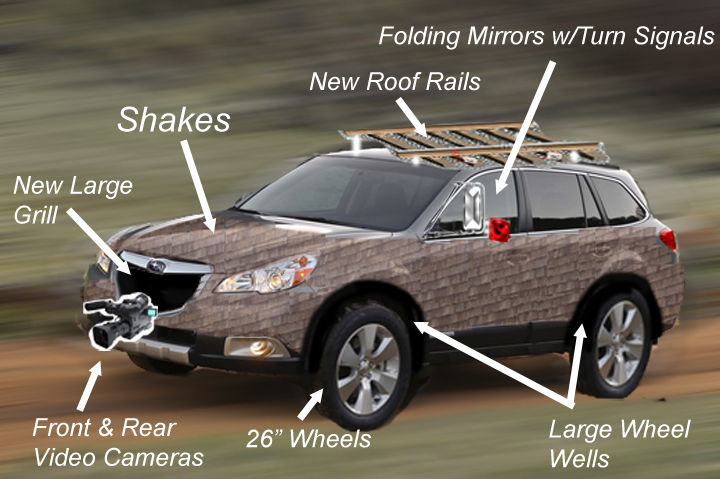
Specifications prices Modifications and Image 2011 Subaru Outback
The 2011 Subaru Outback is named after a mammoth, flat expanse of Australia filled with red dirt, dingoes and places with names like Woolloomooloo. With its generous ground clearance and standard all-wheel drive, the Outback would probably be pretty good at dealing with the deserted vastness of the Outback. Here in the United States, though, Subaru's blending of wagon and SUV has become a favorite for those who live in mountainous and/or snowy climates. Yet, because of last year's full redesign, the Outback is now bigger and more comfortable than before, catering better to those who live in a variety of places and climates.

While we lament that this increase in size removed much of the responsive and fun-to-drive nature from the Outback, its massive increase in sales certainly shows that these "big" changes are resonating with the crossover-buying populace. Interior space is of particular note, as there's plenty of headroom, loads of rear seat sprawl space and more cargo capacity than many midsize SUVs. If you can't fit all your cargo inside, adjustable roof rails easily swing inward to serve double duty as cross rails. It's a nifty feature that cuts down on the wind noise and air drag that go along with fixed cross rails.

Despite the Outback's size, the use of high-tensile steel allows it to earn perfect crash scores across the board and keep weight down. In fact, the Outback weighs about 550 pounds less than a Toyota Venza. This certainly makes things easier for the four- and six-cylinder "boxer" engines. Although the latter provides more than enough gusto for those who live in those mountainous places, the four-cylinder's impressive fuel economy when equipped with the optional continuously variable transmission (CVT) should make it the choice for most. Unfortunately, a turbocharged engine is no longer available -- the previous Outback's turbo engine helped compensate for the typical power drop in high-altitude environments.

However, now that the Outback is more crossover than wagon, it does have a greater number of vehicles it must compete with such as the Chevy Equinox, Honda CR-V and Toyota RAV4. There's also Subaru's similarly sized Forester, though the Outback differs with a higher-quality interior, a quieter and more comfortable ride and a more carlike driving position. Should you desire a more traditional wagon with better handling than the big-boned Outback, the Volvo V50 and VW Jetta are good choices.

All are worth a look but in general we're impressed with the 2011 Subaru Outback and think it now appeals to a greater number of people. Whether you live in Woolloomooloo or Walla Walla, Washington, the Outback should be able to tackle whatever Mother Nature or your family throws at it.
INTERIOR
The current Outback is roomier than pre-2010 models. Added roof height makes the new Outback roomier, with an additional 8 cubic feet of passenger space, and another 5.9 cubic feet of cargo area with the seats folded. Front legroom, still ample for taller drivers, has actually been trimmed slightly in favor of making the back seat more comfortable for long trips. Rear legroom is extended by 4 inches, and the use of curved front seatbacks adds knee room as well.

The Outback models we drove had Premium trim and the better, 10-way driver's seat. The standard seats, four-way adjustable, might not be as adjustable, but they are well designed and there is lots of legroom and headroom. The cabin feels roomy, even after a long day of driving. There is a standard cargo tray, under floor storage, and grocery bag hooks behind the rear seats.

Past Subaru interiors might have been considered quirky, but the current Outback incorporates mainstream design and content characteristics. The dash and cockpit are built around a sporty, four-dial instrument panel and a contemporary upswept center stack. The instrument panel includes a multi-information display that indicates outside temperature, fuel consumption, time, and warning functions for seatbelts and passenger air bags. The transmission gear readout is digital. The steering wheel, a three-spoke design, has four large buttons to control the audio system and cruise control. When equipped with an automatic transmission, paddle shifters are located behind the wheel. Taken as a whole, the interior is clean and contemporary, without being excessively ornate.

The parking brake is controlled electronically via a button to the left of the steering wheel, and has a Hill Hold feature. Higher trim levels offer voice activated GPS navigation, rear backup camera, Bluetooth, USB/iPod input and other amenities.
EXTERIOR
Employing a car-based four-wheel-independent suspension since its mid-1990s inception, the Outback displays admirable ride quality. It soaks up bumps with little driver disturbance but maintains good control over stretches of broken pavement. Rough pavement can stunt a soft-riding car's reflexes and leave it bobbing up and down, but the Outback suffers little of that.

Steering and handling are good, if not as sharp as they were in the last Outback. Driving enthusiasts will appreciate the steering wheel's heavy weight at low speeds, while average drivers will want more power assist for easier parking-lot maneuvers. On the highway, I could use a little less assist. Holding the wheel at 12 o'clock, it feels a bit too loose.

Find a winding road, however, and the Outback handles well. The steering has good turn-in precision and little midcorner sloppiness. The nose pushes wide in hard corners, exacerbated by our tester's all-season Continental ContiProContact tires, which didn't offer much grip. Stomp hard on the gas coming out of a sweeping corner, though, and you can swing the tail out eventually. Credit the standard all-wheel drive, whose power distribution skews slightly rearward in six-cylinder Outbacks. All automatic Outbacks distribute power between the axles electronically; the manual Outback uses a simpler viscous coupling that's less proactive in doling out power when the wheels start to slip. Still, both systems distribute constant power to each axle. Many on-demand systems send power rearward only when a drive wheel begins to slip; some allow you to enforce a 50/50 split via a locking center differential. We've driven previous Outbacks on trails, and the all-wheel drive — along with an impressive 8.7 inches of ground clearance — make for better capability than you'd expect in a crossover.

Four-wheel-disc antilock brakes are standard, with larger discs installed on six-cylinder Outbacks. The pedal has linear response, making it easy to smooth out your stops. Cram the car full of passengers, and you'll want to plan your stopping distances accordingly. Loaded down with some 500 pounds of cargo, our test car took significantly farther to come to a halt.
ENGINE
The Outback's base engine — a 170-horsepower four-cylinder — delivers leisurely acceleration, in large part because of a continuously variable automatic transmission that's in no hurry to respond to your right foot. (A six-speed manual is standard, but we haven't tested it.) Loaded with passengers, the four-cylinder drivetrain requires patience reaching highway speeds, and it strains to keep up under hard acceleration.

That's not the case with the optional 256-hp six-cylinder. It's a muscular drivetrain, in part because it trades the CVT for a responsive five-speed automatic that's not afraid to hold lower gears or kick down on the highway. Even loaded with cargo, our test car had the sort of torque to pull strongly around town, though getting up to highway speeds didn't leave much extra power on tap.

With the six-cylinder, towing capacity tops out at 3,000 pounds. That's 500 pounds less than many competitors, but the four-cylinder Outback has a 2,700-pound rating — none too shabby for a four-banger.

The combined EPA gas mileage estimates range from 20 mpg with the six-cylinder and automatic to 24 mpg with the four-cylinder and automatic. Both figures are competitive.
SAFETY
The 2011 Subaru Outback comes standard with stability and traction control, four-wheel antilock disc brakes, front side airbags and side curtain airbags. In brake testing, a base 2.5i came to a stop from 60 mph in a longer-than-average 133 feet.

In the government's new, more strenuous crash testing for 2011, the Outback earned an overall rating of four stars out of a possible five, with four stars for overall frontal crash protection and four stars for overall side crash protection.It also achieved the Insurance Institute for Highway Safety's top rating of "Good" in its frontal-offset, side and roof strength tests.
reference:autos.aol.com,www.edmunds.com,www.cars.com

Tuesday, June 28, 2011

2011 Subaru Legacy

Specifications prices Modifications and Image 2011 Subaru Legacy
It's easy to be a copycat. You don't have to think as much and there's less risk of failure. Remaking a known commodity like the "A-Team," for instance, has a better shot of bringing in $500 million than an indie film. The same goes for the midsize family sedan segment, which consists of seemingly countless vehicles that play it safe by riffing on the same formula. One notable exception, however, is the 2011 Subaru Legacy.

For years now, the Legacy has resolutely kept beat with its own drummer, and the current car is little different. While nearly everything else goes with the surefire formula of front-wheel drive and a choice of either inline-4 or V6 power plants, the Legacy keeps on rocking its standard all-wheel-drive and horizontally opposed four- and six-cylinder engines, including one that's turbocharged. Then there's the styling, which has always stood out from the crowd -- for better or worse. Despite setting itself apart in such key areas, however, the Subaru Legacy is still a viable family sedan, with top crash test scores, decent four-cylinder fuel economy and comfortable driving dynamics.

However, some of the Legacy's quirks do have downsides. Standard all-wheel drive has obvious traction benefits in poor weather, but the associated mechanical inefficiencies keep the Legacy from being as competitive in fuel economy and acceleration as it could. The turbocharged 2.5GT isn't available with an automatic transmission, which limits its widespread appeal. Also, increasingly common electronic features like Bluetooth, iPod control and navigation are either haphazardly designed or only available in the top-of-the line Limited model with navigation.

Certainly, being a bit different means the Legacy is unlikely to ever match the mighty Accord and Camry for sales supremacy, but it does mean that it has burrowed out a little niche for itself. Still, there are others to consider. The Ford Fusion and Suzuki Kizashi also offer all-wheel-drive, while the Mazda 6 is a good choice for driving enthusiasts. The new Hyundai Sonata is also a class-leading, well-rounded family sedan. Yet, if you're the sort of person who doesn't automatically follow the crowd, the 2011 Subaru Legacy is a solid, non-conformist choice.
INTERIOR
The Legacy's interior design is sleek and sophisticated, but you better like silver paint, because the center stack is covered with it. Though the interior plastics look upscale, most of them are hard to the touch and lack the more premium feel found in models such as the Ford Fusion.

The seats are comfortable and the Legacy's provide plenty of headroom and rear seat legroom. In terms of technology, iPod control and streaming Bluetooth audio are available, but you have to ante up for the top-of-the-line Limited trim in order to get it. We've also noticed the nav system's functionality is hampered by fussy controls and small touchscreen icons. You should also note that sound quality from the base sound system is poor and we highly recommend the available Harman Kardon upgrade system. Trunk space is an average 14.7 cubic feet.
EXTERIOR
Outside, the 2010 model is much more assertive than the outgoing car, which itself was a bit of a shrinking violet. After the departure of designer Andreas Zapatinas and his Edselian B9 Tribeca, the Pleiades brand seemed to lose a bit of its design nerve and the will to create a unified corporate face. But now, it finally seems to be seeking out its mojo once again with this new Legacy.

We're not entirely sure this is a good thing, as the Legacy has gone from understated confidence to a jumble of incomplete ideas (Chrysler Sebring hawkeye headlamps, chrome-happy "wing" grille, hulking flared fenders to emphasize the car's all-wheel drive) that fail to live in complete harmony with each other. We'll leave final judgment up to you, only with the knowledge that the whole package looks better on the street than it does in photos (particularly when fitted with larger alloys that don't get lost in the cartoonishly overemphasized wells) and our divisiveness towards it softened over time. Thankfully, Subaru sales have never been predicated on beautiful sheetmetal, and we can't see this model being any different.

Open up the wider-angle, newly-framed doors (the old, rattle-prone sashless jobbies are gone), and a significantly larger and much-improved interior awaits. Dominating the instrument panel is a silver-effect center stack topped with a birdbath-like information display. The vertical array houses the usual complement of audio and HVAC controls (along with an eight-inch navigation screen if so-optioned), and it has a deep storage pocket for odds-n-ends. Plastics are nicely grained and solid fit-and-finish was in evidence, but greater use of soft-touch surfaces and more sincere-looking faux wood trim on Limited models wouldn't go amiss.

All the controls are easy to reach and intuitive to use, with the exception of a too-crowded and too-low panel that houses the power mirror controls, electronic parking brake, hillholder and traction control defeat buttons, trunk release, gauge brightness control, and a couple of odd-looking blanks. It's simple enough to use once you get the hang of it, but we'd prefer to see the parking brake located on the center console and a larger, separate trunk release. We were a bit surprised not to see the availability of some sort of keyless start system, but as they're often more trouble than they're worth, the absence isn't worth grousing over.

In addition to its obviously heightened quality, the big story with the 2010's interior is its newfound space. In particular, rear accommodations are now genuinely large, with an extra four inches of legroom thanks to the longer wheelbase and deeply scooped-out front seatbacks. Our six-foot, five-inch co-driver had no trouble getting comfortable, and even when he was in situ, there was plenty of knee- and toe-room left behind him for full-grown adults. Total EPA volume is up by 9% to 117.7 cubic feet and betters that of the Toyota Camry and Volkswagen Passat, while trunk space swells by 29% to 14.7 cubic feet (more capacity than Honda's larger Accord).
ENGINE
At the bottom of the lineup, the 2.5i continues with a mostly carryover 2.5-liter, 170-horsepower four-cylinder. Subaru says that a new resin-based intake manifold lowers the engine's weight and improves low-end torque, which stands at 170 lb-ft. -- now at 4,000 rpm versus 4,400 rpm before. Subaru also says that improved cooling and a revised catalyst will boost fuel economy figures above the 20/27 (manual) and 18/25 (automatic) before. The 2.5i will now come standard with a six-speed manual (versus a five-speed in 2009) and it will offer a CVT automatic rather than the four-speed conventional automatic from before.

The 2.5GT features a revised 2.5-liter turbocharged boxer four with 265-horsepower and 258 lb-ft (a 22 horse and 17 lb-ft. improved over the old model). A modified turbocharger and a reduction in rpms required for peak torque -- the torque curve is flat from 2,000 rpm to 5,600 rpm, Subaru says -- make it both faster and more efficient than before. A six-speed manual and five-speed automatic remain available.

At the top of the range, the 3.6R model gets an uprated version of the 3.0-liter flat-six previously offered. Subaru says that the 3.6-liter six, which now uses regular fuel, puts out 256-horsepower and 247 lb-ft. of torque (compared to 245/215 from the outgoing engine). It�€™ll be paired to a five-speed automatic exclusively.

The CVT in the 2.5i, which is expected to make up the bulk of sales if historical figures are to be considered, is the first longitudinally-mounted CVT system in an all-wheel-drive car.
SAFETY
Every 2011 Legacy comes standard with stability and traction control, antilock disc brakes, front side airbags and side curtain airbags. In Edmunds brake testing, the 2.5i came to a stop from 60 mph in a good distance of 121 feet and the 3.6R was in the same ballpark. The 2.5GT stopped in an excellent 111 feet.

In the government's new, more strenuous crash testing for 2011, the Legacy earned an overall rating of four stars out of a possible five, with four stars for overall frontal crash protection and four stars for overall side crash protection. The Insurance Institute for Highway Safety also gave the Legacy its perfect score of "Good" in the frontal-offset, side and roof strength tests.
reference:autos.aol.com,www.leftlanenews.com,www.edmunds.com

Toyota Etios Liva Price, features, specs – complete lowdown

Toyota Kirloskar has officially launched the Etios Liva in India, at a staggering base price of Rs. 3.99 ex-Delhi. The car, as we told you earlier, is available in five variants. The variants, and their respective pricing is listed below.
  • J: 3.99 lakh
  • G: 4.59 lakh
  • G SE: 5.05 lakh
  • V: 5.49 lakh
  • VX: 5.99 lakh

The base variant, although priced very aggressively is devoid of features.

  • Engine: 1197cc naturally aspirated, inline four engine
  • Power: 80PS @ 5600 rpm
  • Torque: 10.6 kgm @ 3100 rpm
  • 3 years 100,000 kilometers conditional warranty
  • Transmission: 5-speed manual
  • Best in class ARAI certified fuel efficiency of 18.31kmpl
  • Best in class head, knee and leg room
  • Audio system with Aux-in and USB jacks
  • Engine tuned for city driving, and better efficiency than outright performance
  • Twin front airbags and ABS available in the top variants
  • Liva meant for primarily the young, who want to achieve
  • Tagline for the Liva – Live tomorrow, Today! (in SMS slang – something that best represents today’s youth)
  • Rust protection, anti-chip paint and protection under the belly
    Etios Liva available in 7 colours
  • Large glove box with 13.0 liter capacity, can hold upto nine 500 ml water bottles and is a/c cooled.
  • 7 one-liter water bottle holders in the cabin
  • Plenty of other cubbyholes for knick-knacks
  • Variants : J, G, V , VX – just like the Etios sedan, with VX being the top of the line variant and J being the lowest spec
  • Kerb weight of 920kg makes it one of the lightest cars around. Class leading 85.8bhp/tonne power to weight ratio. Base variant only 890 kg.
  • Engine a derivative of the 1.5-liter Etios sedan power plant. Essentially employs a shorter stroke. As a characteristic property of short stroke engines, the low end driveability shouldn’t be too great
  • Top variants get some really neat visual add-ons such as chin spoiler, side skirts and roof spoiler
  • Styling remains true to its sedan sibling to the tee
  • Liberal shoulder and leg space at the back seat
  • 251 liters of boot space
  • Rear seat foldable, but not split
  • Steering mounted audio controls on the top of the line VX variant
  • Good ground clearance of 170mm
  • Fuel Tank : 45 liters
  • The ride quality of the car is said to be acceptable
  • Official launch on the 27th of July, along with disclosure of prices

Check out the brochure image below for more details on variants and their respective features. Click Twice to see the image in full

Etios Liva Colours, Trims and Dimensions


Official Toyota Etios Liva Press Release

Toyota Kirloskar Motor Launches its first ever hatchback in India for India – Etios Liva

Youthful and sporty design, best-in-class cabin space & fuel efficiency, superior ride comfort and the legendary Toyota QDR standard

· Hiroji Onishi , President TMAP launches the Etios Liva

· Toyota forays into the popular hatchback segment

· Price starts at 3.99 Lakhs ex showroom Delhi

· Booking and deliveries start today

June 27, 2011, Delhi: Toyota Kirloskar Motor (TKM) today announced its entry into the popular hatchback segment in India, with the launch of Etios Liva. Etios sedan and the hatchback Etios Liva – built on the same platform – have been specifically developed for the Indian customers. Etios Liva inherits its name from its sedan, Etios. The word Liva has been coined from the dynamic and positive terms – Lively and Live life to the fullest – which reflect the spirit and image of the car. It is targeted at today’s youth whose spirit and belief is translated into the advertising line for Etios Liva -“LIV TMRRW 2DAY”.

Tagged – ‘Q Class Hatch’ – Etios Liva is stylishly designed and portrays a youthful and sporty image. Etios Liva will carry forward the ‘Q’ Class experience from Etios and will offer Toyota’s legendary QDR standard – Quality, Durability and Reliability at an affordable price.

Etios Liva will be available in four variants, J, G, V and VX, competitively priced between 3.99 Lakhs and 5.99 Lakhs ex-showroom Delhi. The product highlights include youthful and sporty design, best-in-class cabin space, superior ride comfort and best-in-class fuel efficiency.

Etios Liva was launched by Mr. Hiroji Onishi, (President, Toyota Motor Asia Pacific, Marketing and Sales) in the presence of Mr. Vikram Kirloskar (Vice Chairman, TKM), Mr. Hiroshi Nakagawa (Managing Director, TKM), Mr. Sandeep Singh (Deputy Managing Director-Marketing, TKM) and Mr. Yoshinori Noritake, (Chief Engineer of the Etios and Etios Liva, Toyota Motor Corporation).

Commenting on the launch of the Etios Liva, Mr. Hiroji Onishi, President, TMAP, Marketing and Sales said: “India is an integral part of our global growth strategy. The Etios project is a milestone not only for Toyota in India but for Toyota globally. The Etios Liva has been designed focusing on the Indian customer’s aspirations, tastes and preferences that were gathered, studied and understood through extensive research. We are delighted by the overwhelming response received by the Etios customers. The Etios has been well accepted by our customers. We hope the Etios Liva will further reinforce the Toyota brand in India, making Toyota a household name.”

Mr. Vikram Kirloskar, Vice Chairman, TKM, said “The Etios project is the first of its kind not for TKM alone, but also for Toyota across the globe. The key to this project, is to make TKM self sufficient by increasing the level of localization. As announced earlier, we plan to locally produce engines and transmissions at Toyota Kirloskar Auto Parts, in the third quarter of 2012. This will help us increase the local parts content in the Etios and further contribute to the social and economic growth, by enhancing self sufficiency, generating employment and expanding operations in India. Localization will further help us develop our suppliers and facilitate them to meet global standards of production. It will also generate employment and provide opportunity for expansion and growth, further strengthening our supplier base in India.”

Speaking on the occasion, Mr. Hiroshi Nakagawa, MD, TKM, said “I would like to take this opportunity to thank all our Etios customers. After the good response received by the Etios, we further expanded our production in order to cater to the huge demand. The annual production capacity will be increased to 2,10,000 units by the second quarter of 2012.

In line with our ‘customer first philosophy’, we wish to keep our customers happy and satisfied by understanding the customer’s preferences and enhancing the product by incorporating their feedback. With the Etios Liva we have now entered the mass volume segment. Toyota vehicles are now available to all aspirational buyers in the middle income group.

At Toyota, we truly believe in growing with the society. We wish to sell many more vehicles and contribute to the growth of the Indian automobile industry. Entering into the mass volume segment will help us realize this aim.”

Mr. Yoshinori Noritake, Chief Engineer of Etios and Etios Liva said “With the Etios Liva, we aspire to offer the best suited car for the Indian customer at an affordable price, while providing a vehicle that is “one class above”. After interviewing and studying the customer preferences in India, we found, the need for affordably priced, quality cars was constantly growing. We first observed various aspects that were sought after by the customer and then enhanced the features and performance aspects that were truly needed while doing away with the excessive design elements.

The stylish, sporty and trendy Etios Liva has been designed to appeal to today’s youth. We have also added style by offering aero kits with front, rear and side skirt that is sure to make heads turn. The sporty steering wheel, instrument panel -designed to give a aircraft cockpit image, a premium audio system, audio system with Aux in, USB and a wireless remote adds on to the fun, youthful and sporty image of the car.”

Talking about the Etios Sales and Marketing strategy in India, Sandeep Singh, DMD-Marketing, TKM, said “ The marketing campaign for the Etios Liva is exciting, innovative and abreast with the latest marketing tools, digital initiatives and promotions. Promotional activities targeting the youth have been planned in the popular youth hangouts like malls, pubs and also in colleges. Music maestro A R Rahman, the Brand Ambassador for Etios and Etios Liva has composed a special tune for Etios Liva ad campaign. He will also feature in a trendy music video. The music composed by Rahman, captures the spirit of today’s youth and the sporty image of Etios Liva – “Bari Hamari Hai” (Its our turn now). Watch out for Rahman’s Etios Liva tune in the TV commercial and the music video on your television screens starting today. It is also available on our website www.toyotaetiosliva.in and www.toyotabharat.com.

We have more than 20,000 happy Etios customers across the nation. Etios has been received well and appreciated by our customers. The sale for Etios was overwhelming, as we sold more than we actually planned. We have brought down the waiting period to less than a month by increasing the production. We look forward to serving more and more customers with Etios Liva and hope that we continue to delight our customers with the Q Class experience. Etios Liva will go on sale and is on display at all our dealerships starting today. We currently have 158 dealerships and will expand our dealer network to 175 by the end of this year. We aim to come closer to our customers and help them avail the best of Toyota’s “Q” Class Service. ”

Vehicle Outline

Exterior

Etios Liva is designed around the concept of ‘Bold Simplicity’. A cutting-edge and leading design that aims for a body frame and stance that stands out in a crowd. A distinctive front grille with a smile line, sculpted surface and dynamic character-line in the front and rear, enhance the presence of the Etios

Liva. The aero kit – with front and rear bumper skirt, side skirt and roof spoiler. The roof has a unique design for better aerodynamics and clean appearance.

Interior

The two toned ergonomically designed interiors are comfortable and sporty. The area surrounding the driver’s seat is given the image of a cockpit by separating the operating zone from the display zone. Large centre meter panel, that provides excellent visibility and easy to read dials. The interiors are simple yet functional, giving a high sense of quality.

The Etios Liva has best-in-class cabin space, large boot space with 251L capacity, a spacious 13L cooled glove box, seven one litre bottle holders, mobile holder and many more such useful storage spaces inside the car.

Performance and Comfort

A newly developed 1.2L, 16V DOHC engine coupled with a 5-Speed manual transmission that produces high output for superior driving performance. The torque is available at low rpm for less gear shifting and stress-free city driving.

The Etios has a best-in-class mileage of 18.31kmpl as certified by testing agency.

Electric power steering for excellent maneuverability and tilt steering ensures a good ergonomic driving experience. The steering comes with audio controls for comfort at the driver’s fingertips.

The flat type rear floor design offers ease of movement for rear seat passengers. With its rigid body structure and world class Mac Pherson Strut, the Etios has superior dampening performance providing superior ride comfort.

A class-first ‘clean air filter’ which is standard across all grades for purified air in the cabin.

Safety

The Etios has various active and passive safety features like (i) Energy absorbing body shell (ii) Driver & Passenger Air bags and (iii) ABS with EBD and (iv) Seatbelts

It’s centrally located combimeter reduces eye movement and hence the driver can concentrate on the road.

Special Treatment

· To adopt to the various diverse climate and usage conditions in India, special treatment and countermeasures have been implemented:

· Good ground clearance of 170mm

· Under body protection to prevent damage to fuel and brake lines

· Anti-corrosion steel sheets at areas prone to rusting and stone hits

· Chipping resistant paint on rocker mould & fender

Saturday, June 25, 2011

2010 BMW 320d Efficientdynamics Edition car preview and wallpapers

2010 BMW 320d Efficientdynamics Edition car preview and wallpapers